
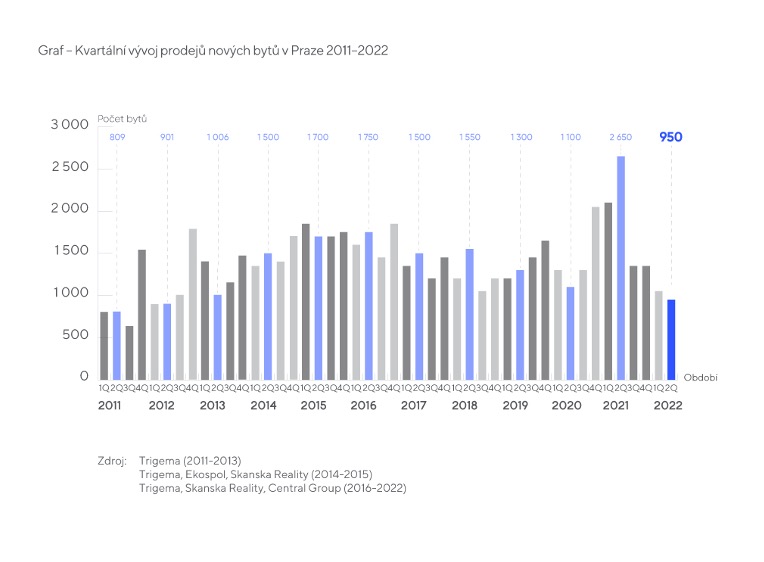
The second quarter of 2022 saw stabilisation in the price of new apartments in Prague. The current average sales price of 145,783 CZK/m2 is similar to the first quarter, although it still represents a 20% increase year-on-year. Over the last three months, more newly added apartment units have also appeared on the market. In total, 950 new apartments were sold in the second quarter this year, representing a third fewer compared to the long-term average. This is mainly the result of mortgage unavailability as a result of a record increase in interest rates for new loans. This data comes from market analysis undertaken by Trigema, Skanska and Central Group.
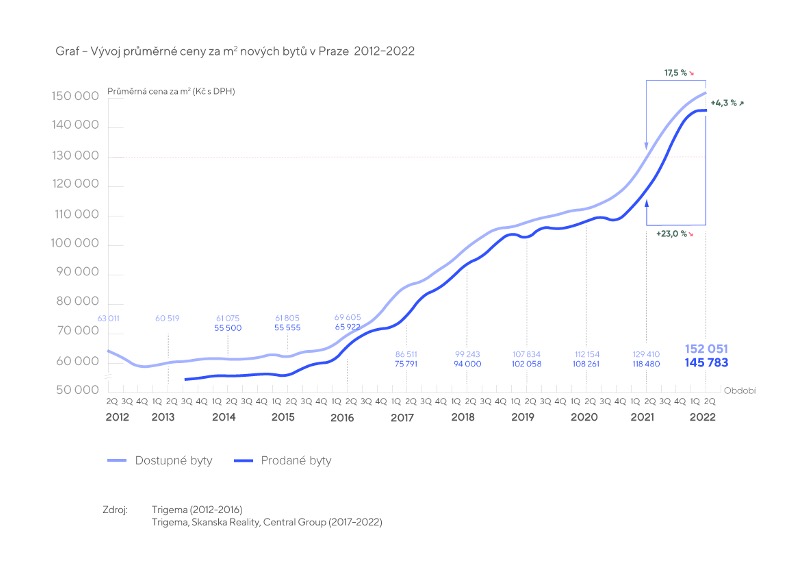
Despite the continuing rising prices of key inputs and persistent uncertainty regarding the future development of the construction market during a period of high inflation, prices of new Prague apartments remained at their original level. Sales prices settled at 145,783 CZK/m2, which represents an increase of just 34 CZK/m2 compared to the first quarter of this year. While the pace of growth has fallen significantly, it still represents a 23% increase year-on-year.
The growth in bid prices also slowed, although this still exceeded 150 thousand CZK/m2 (152,051 CZK/m2, a 17 % increase year-on-year). Thus, bid prices are diverging from sales prices, and are returning to the long-term level of a difference of around 5-10%. This increase mainly arises from the prices of newly added projects, whose average price reached 157,401 CZK/m2 in the second quarter this year, one reason for this being the escalating prices of input materials. Although the prices of selected construction materials began to stabilise in the final weeks of the second quarter, they remain difficult to obtain due to disruptions in supplier-customer relations caused by the war in Ukraine.
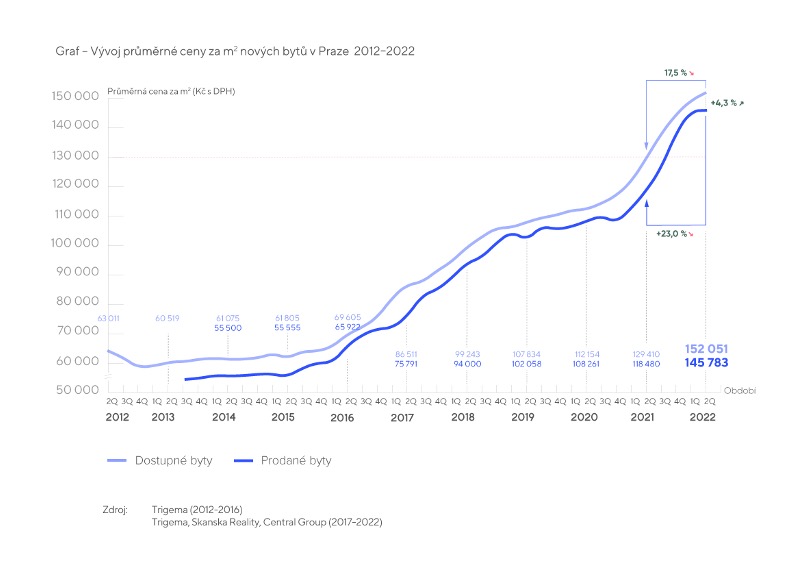
“In a year-on-year comparison, the prices of new apartments in Prague grew by around a fifth. But recently prices have stabilised, and have increased by only around 5% since the start of the year. We expect growth of a maximum of 10 % in total this year. This is mainly because of the reduction in people buying an apartment through a mortgage. Mortgage interest rates have soared and are now roughly three times what they were a year ago. As a result, most people are putting off buying property through mortgages, and waiting for rates to fall again,” says founder and head of Central Group, Dušan Kunovský.
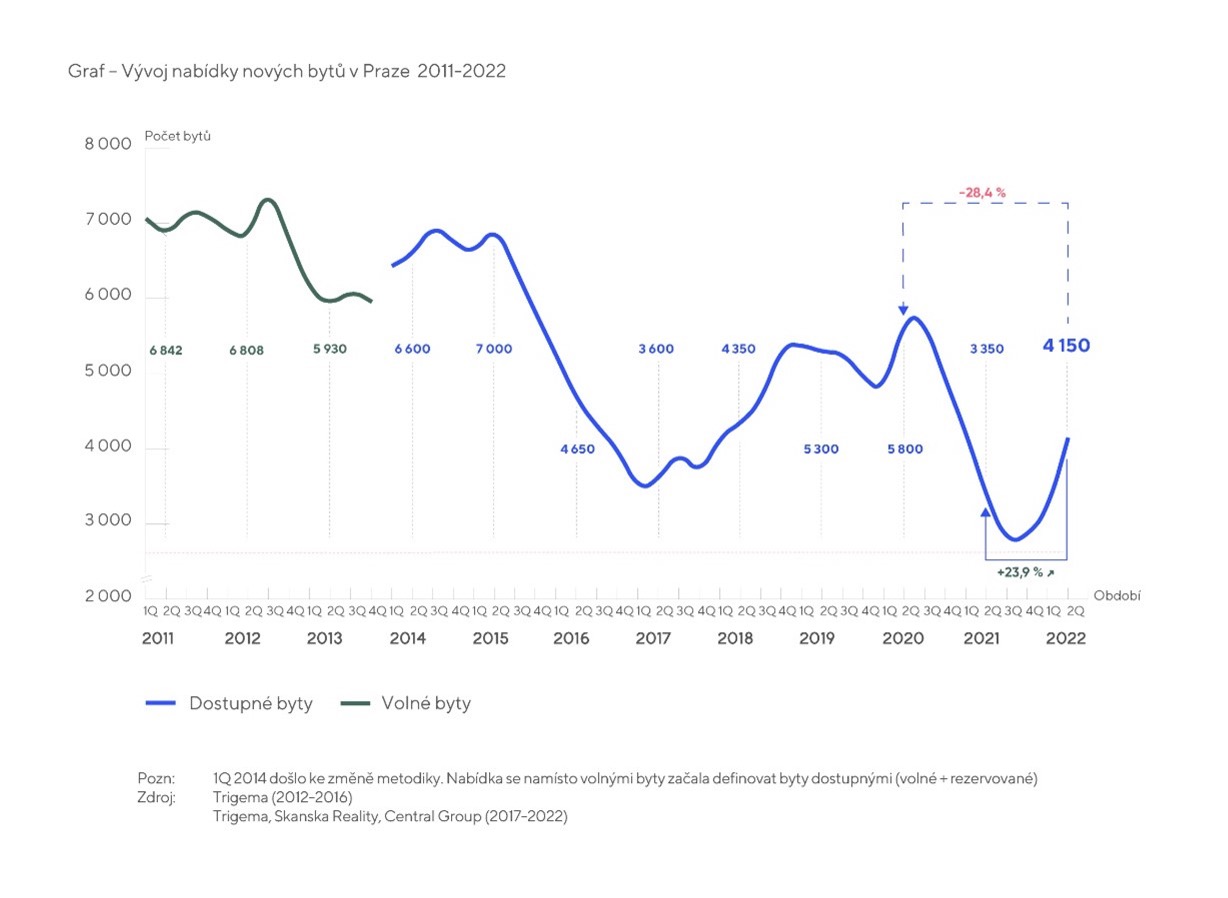
The supply shortage is one of the main causes which has been impacting the price of new homes in Prague for many years. The housing supply, which record sales in the past two years reduced to a historical minimum, has now increased to 4,150 apartments. This is an increase of almost a quarter year-on-year. Even so, the supply remains around 15 % below the long-term average and over 50 % below conditions where demand would be sufficiently saturated, leading to a partial stabilisation in the new apartments market. Long-term poor supply is mainly the result of the complex approval process for new buildings, preventing the market from being supplied with the necessary number of new apartments.
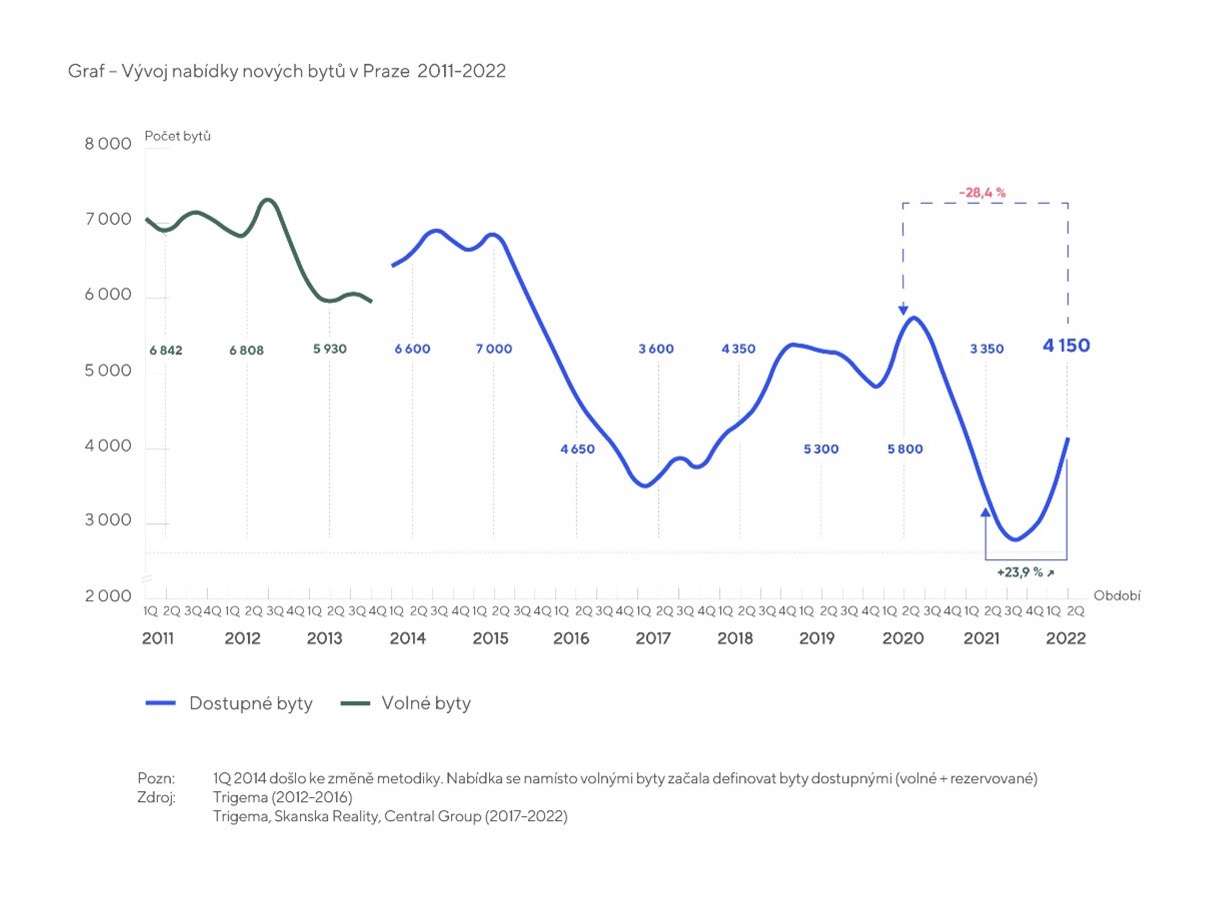
“Despite the slight increase, the supply of available apartments, especially in the capital, remains weak. In order to satisfy market needs, we would need around twice the current supply. Furthermore, it is possible that the coming crisis will have a severe impact on some smaller developers, who will be forced to stop being apartments completely, leading to a further decrease in supply,” explains Marcel Soural, Chairman of the Board at Trigema Investment Group.
Numbers of sales of new apartments in Prague have been impacted by a combination of a number of factors mainly connected to uncertainty regarding future developments and price increases. Poor accessibility to mortgages as a result of the steep rise in the base interest rate has had a fundamental impact, however. The base interest rate has reached seven percent, the highest level since 1999. The Czech Banking Association’s Hypomonitor survey records a year-on-year decrease in the volume and number of new mortgages of up to 60 % for the second quarter of this year. This also relates to apartments going back on sale, this number higher only with the onset of the coronavirus pandemic in the second quarter of 2020. Many of those looking to use a mortgage to purchase a new home have now been forced to postpone their purchases. In total 950 new apartments were sold in Prague in the second quarter this year. Compared to the second quarter last year, this is a 64% in the number of apartments sold, although compared to the long-term average it is only a fall of a third.
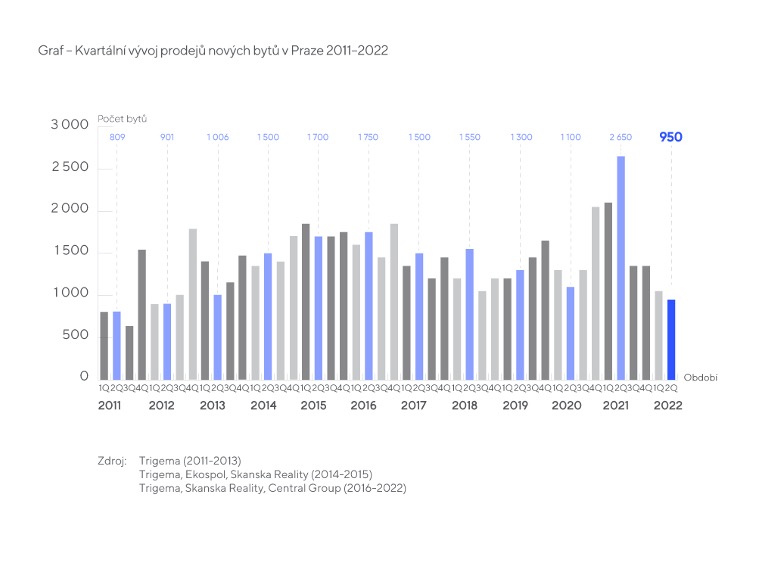
“The current situation in the mortgage market has basically transformed the structure of buyers. While in the past most clients funded their new home with a mortgage, today it is purchases an investments which predominate. The demand for new homes in Prague remains, but certain clients, mostly those under 30 years of age, are unable to get a mortgage under current conditions, and have had to postpone the acquisition of a new home. As such, purchasers today are more commonly those who are buying a new apartment to protect their money against increasing inflation,” says Petr Michálek, General Director of Skanska Reality a.s.